Search is changing.
For years, businesses have focused on SEO to rank higher on Google and bring in organic traffic. But more people are now turning to tools like ChatGPT, Google AI Overviews, Microsoft Copilot and Perplexity to ask questions, compare options and research products and services. That shift has given rise to two terms that keep coming up in digital marketing: Answer Engine Optimisation (AEO) and Generative Engine Optimisation (GEO).
What do they actually mean, and is there anything businesses should be doing about them right now?
SEO, AEO and GEO: what’s the difference?
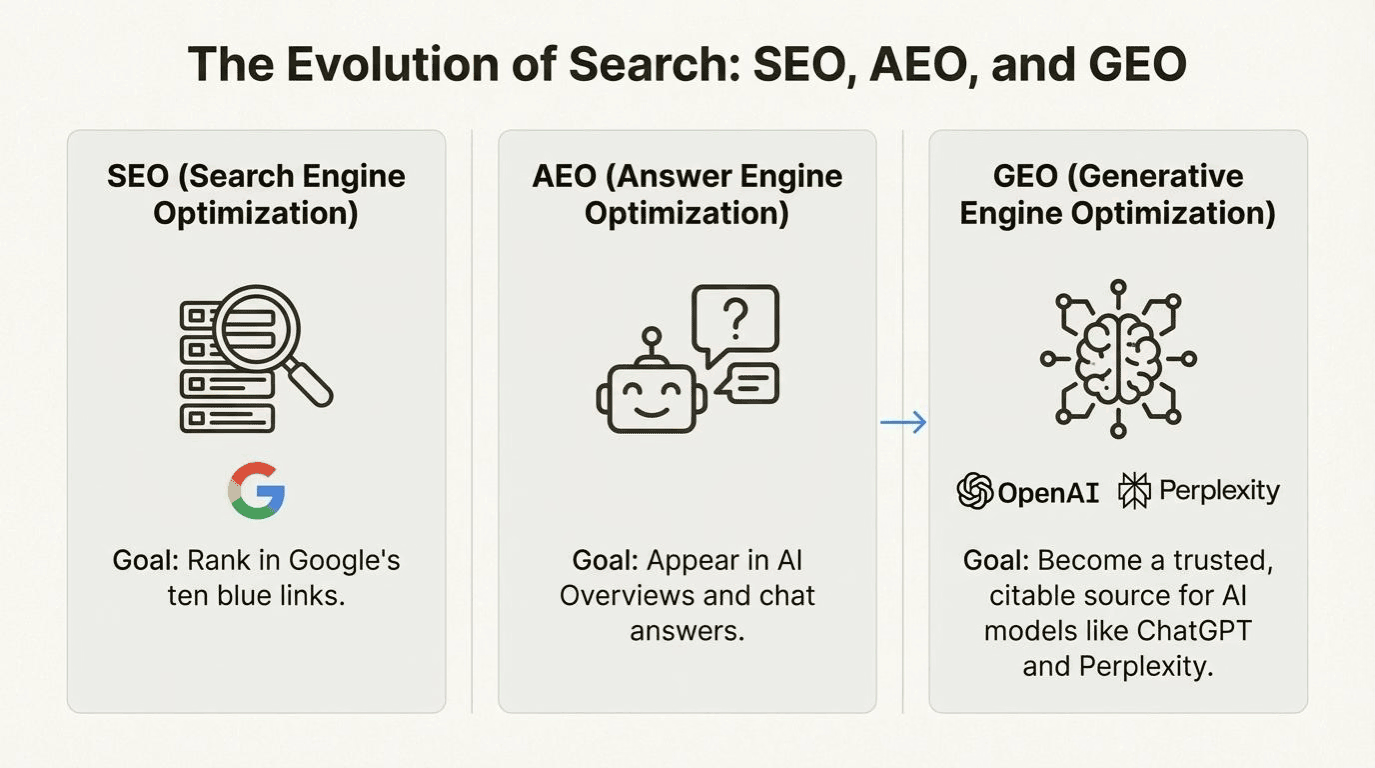
The three are closely related but focus on different things.
SEO is about improving your website’s visibility in traditional search results.
AEO is about structuring and presenting content so it can be easily understood and surfaced as a direct answer to a user’s question.
GEO is about improving the odds that a brand or website gets surfaced, mentioned or cited when AI tools generate an answer. It’s a term originating from academic research measuring visibility in AI-generated answers.
There’s plenty of overlap between each. A well-written article answering a customer’s question clearly is useful for traditional search, AEO and GEO all at once. So AEO and GEO aren’t really replacements for SEO, they’re another layer of the same overall strategy.
Why this matters now
AI-driven search is already happening. Adobe Analytics found that traffic from generative AI sources to US retail websites grew 1,200% between July 2024 and February 2025, and referral traffic from these tools was up 1,300% year over year during the 2024 holiday season. Visitors from AI tools also behaved differently. Over the same period, they viewed 12% more pages, spent 41% longer on site, and had a 23% lower bounce rate than visitors from other sources.
The trend continued through 2025. By May, Adobe reported AI-driven retail traffic had grown 35x since July 2024, with a 27% lower bounce rate and 38% longer time on site. By the 2025 holiday season, generative AI referrals to retail sites were up 693.4% year over year, and that traffic converted 31% better than other traffic.
None of this means AI search has replaced Google. Traditional search is still the biggest traffic source for most businesses. But it does show that AI is becoming another way people discover websites, and it’s worth factoring into your digital strategy.
Can small businesses actually benefit from GEO?
It’s tempting to assume GEO mostly benefits large, well-known brands. Established companies already have years of content, reviews, backlinks and press coverage for an AI system to draw on. A smaller business usually doesn’t have that same footprint, and publishing a handful of GEO-optimised articles isn’t going to suddenly get ChatGPT recommending you.
That doesn’t mean GEO has no value for smaller businesses, the goal just needs to be different. Instead of asking “How do we get ChatGPT to recommend us?”, a better starting question is “What do we know well enough to explain clearly and credibly?”
Take a small HR software company as an example. Rather than writing article after article about why its own product is the best, it’s more useful to answer what customers are actually asking: what should an onboarding process include, which documents need to be collected, what mistakes come up most often, what to look for when choosing HR software. That kind of content is useful whether someone finds it via Google, an AI tool, or the company’s own site, and it only gets more valuable as customer insights, real examples and industry data get added to it over time.
Original data is one real advantage smaller businesses have. You don’t need to be a household name to have something worth sharing. Years of working with customers is often enough. An HR software provider that analyses its own anonymised onboarding data might find, for example, that incomplete documentation is one of the most common causes of onboarding delays across 2,000 records. That’s far more useful than another generic explainer on what onboarding is, and findings like this are also more likely to get picked up by other sites or industry publications, which in turn helps build the third-party presence that GEO relies on.
For a small business, this is realistically a gradual process: first make sure your website is accessible to search engines and clearly communicates what your business does, then build content and original information that demonstrates real expertise, and let citations and mentions accumulate from there. That can improve a business’s chances of being surfaced in relevant AI-generated answers over time, but there is still no guarantee, since results vary by platform and query. A more grounded goal is simply to build up a body of genuinely useful, credible content in your area. Even without an AI citation, that content still does its job for customers.
10 Practical Ways to Improve Your Website for AEO and GEO
There’s no single formula that guarantees a website shows up in ChatGPT. But most of what makes content useful for AI is also just good practice for traditional search and for people reading it.
1. Answer the questions customers actually ask
Rather than writing to rank for a keyword like “HR onboarding software,” look at what’s really behind that search. Questions like what a good onboarding system should include, how to cut down on onboarding errors, or which documents need to be collected. Answer the question clearly near the top of the relevant section, then add detail underneath. It’s easier for people to read and gives search and AI systems something clear to work with.
2. Use clear headings and a logical structure
A page doesn’t need to be complicated to be useful. Descriptive headings, short paragraphs, and bullet points or tables should be used when they genuinely help, not for their own sake, but to make a page easier for people to scan and for search and AI systems to parse. AI systems extract from clearly structured pages, including using headings and logical sections to extract and use the right piece of information.
3. Write for search intent, not just keywords
Someone searching “HR software” might just want a definition. Whereas, someone searching “What’s the best HR software for a 100-person company?” is probably comparing options and thinking about a purchase. Same general topic, very different intent, and AI search especially tends to handle longer, conversational questions well, so content should address the context behind a query rather than just repeating a target keyword.
4. Back up claims with evidence
If you make a claim, give people a reason to believe it. Statistics, research, original data, customer results, benchmarks, expert input, case studies. Saying “structured data can improve search performance” is a lot less useful than explaining what structured data actually does and linking content to reliable documentation. Google itself recommends that structured data be accurate, complete and relevant, not added purely for optimisation’s sake.
5. Publish original information, not another summary
There’s already a huge amount of generic content online, and an eleventh version of the same explanation that ten other sites have already written doesn’t add much. What’s harder to copy, and more worth the effort, is original research, survey results, internal benchmarks, product comparisons, first-hand experience and case studies. A business that’s worked with hundreds of customers often has trends or lessons that don’t show up in a standard industry article. This lines up with Google’s own guidance, which emphasises helpful, people-first content over content produced mainly to attract search traffic.
6. Make it clear who’s behind the content
Basic information about your organisation and authors should be easy to find: what the company specialises in, who wrote the article and what experience they bring, what evidence backs up the information. Clear authority matters at the page level but also at the domain level. A site with an ongoing body of content on a subject tends to carry more weight than a single well-credentialed article, since it signals sustained expertise. Organisation-level structured data can help Google understand and distinguish your business, and for smaller companies especially, being upfront about your area of expertise helps build credibility over time.
7. Use structured data where it makes sense
Structured data adds machine-readable labels to information already on a page, telling search engines explicitly that a certain field is a product name, a price, a rating, and so on. Google recommends JSON-LD when it is practical, and can support structured data across articles, products, events, organisations and software applications. It’s worth keeping expectations realistic here: structured data doesn’t guarantee a rich result or a ranking boost. The point is making content easier for machines to understand, not adding as much markup as possible.
8. Keep important information current
Outdated pricing, product details, policies, regulations or statistics can quickly undermine a site’s usefulness. An article titled “The Complete Guide to HR Onboarding in 2024” will age fast as regulations, tools and common practice shift. Although freshness isn’t a core benchmark for AI search the way it is for breaking news, a well-maintained evergreen page can still perform well long after it was first published. The goal isn’t a recent timestamp for its own sake, but making sure the facts on the page are still true. Reviewing key pages regularly and updating facts, examples and sources keeps content worth trusting.
9. Look beyond clicks
Traditional SEO reporting leans on rankings, impressions and clicks. AI search adds a different question: is your business getting mentioned or cited when people ask relevant questions? Someone asking an AI assistant for good accounting software options might get a full answer with citations and never visit a traditional results page at all, so visibility inside an AI-generated answer can matter even without a click.
Early research analysing more than 21,000 citations across ChatGPT, Google AI Overview and Perplexity found that getting cited and actually shaping the answer aren’t the same thing. Some platforms draw lightly from many sources, while others cite fewer sources but lean on them much more heavily. Pages AI models drew on most heavily were typically longer, well-structured, closely on-topic and rich in extractable information, including definitions, numbers, comparisons and procedures.
That distinction matters for how you measure success, too. Being cited isn’t the same as being influential, so it’s worth tracking more than just mentions. Along with traditional metrics, it’s worth tracking AI mentions and citations, referral traffic from AI platforms, branded search volume and conversions that trace back to AI discovery.
10. Keep doing good SEO
The simplest and most practical point: don’t stop doing SEO. AEO and GEO aren’t shortcuts around the fundamentals. A site still needs to be crawlable, indexable, technically sound, fast, clearly structured and genuinely useful. Google continues to prioritise people-first content, which is really the point: you’re not writing for machines instead of people, just writing clearly enough that machines can follow along too.
Where do we go from here?
AI-assisted search is still evolving, and there’s no universal checklist that guarantees visibility. Results vary by platform and by the type of query, and something that works in one setting won’t necessarily work the same way in ChatGPT, Google or Perplexity.
There’s no shortcut here. The businesses most likely to benefit from AI search are still the ones producing genuinely useful information, demonstrating real expertise, and keeping their websites current. AEO and GEO simply add another reason to make those things a priority.
SEO helped businesses become visible in the age of search engines. AEO and GEO are part of that next stage, as people increasingly ask search and AI tools to just give them the answer directly. The question isn’t only “Can people find our website?” anymore, it’s also “Can our website provide a useful part of the answer?”
References
- Adobe Analytics. Traffic to U.S. Retail Websites from Generative AI Sources Jumps 1,200 Percent. March 2025.
https://blog.adobe.com/en/publish/2025/03/17/adobe-analytics-traffic-to-us-retail-websites-from-generative-ai-sources-jumps-1200-percent - Adobe Digital Insights. The Explosive Rise of Generative AI Referral Traffic. 2025.
https://business.adobe.com/uk/blog/the-explosive-rise-of-generative-ai-referral-traffic - Adobe Digital Insights. Q2 2025 Insights: AI Referrals Surge Across Industries. 2025.
https://business.adobe.com/au/blog/ai-driven-traffic-surges-ahead-in-q2 - Adobe Digital Insights. AI-Driven Traffic Surges Across Industries, Retail Sees Biggest Gains. January 2026.
https://business.adobe.com/blog/ai-driven-traffic-surges-across-industries - Aggarwal, P., Murahari, V., Rajpurohit, T., Kalyan, A., Narasimhan, K. and Deshpande, A. GEO: Generative Engine Optimization. arXiv, 2023.
https://arxiv.org/abs/2311.09735 - Google Search Central. Creating Helpful, Reliable, People-First Content. Google.
https://developers.google.com/search/docs/fundamentals/creating-helpful-content - Google Search Central. General Structured Data Guidelines. Google.
https://developers.google.com/search/docs/appearance/structured-data/sd-policies - Google Search Central. Introduction to Structured Data Markup in Google Search. Google.
https://developers.google.com/search/docs/appearance/structured-data/intro-structured-data - From Citation Selection to Citation Absorption: A Measurement Framework for Generative Engine Optimization Across AI Search Platforms. arXiv, 2026.
https://arxiv.org/abs/2604.25707